Starting Over Is Not Easy ... Mother Baby Child Blog

I was over 35 when I gave birth to Baby Max. My middle son was 11 years old and my older son had just turned seventeen. It wasn't easy starting over again ... Mother Baby Child is a blog to share parenting experiences, as well as what marriage is like after being a single mom for so many years. Get info on having a baby, raising children, babies, tweens, teens, homeschooling, mom blogs, work at home mom. business marketing, Christian and celebrity moms blog posts.
I can do all things through Christ which strengtheneth me. ~ Philippians 4:13 (KJV)
Meet The Mom Blogger | Baby Videos | Freebies / Giveaways | Daily Blog Hops
WAHM Business | Mom Blog Marketing | Google + Moms Community

6 Month Doctor Appointment

6 month immunization, 6 month vaccines, well baby doctors appointment
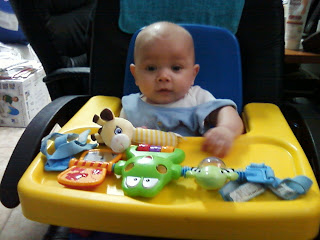
Picture of Baby Max - 6 Month Old - July 2011 - Sits up, watches Sprout on TV, babbles DaDa all day long, follows and tries to grab shadows, plays with toys, eats stage two food in his high chair BUT does NOT want to sleep in his crib at night and hates his nurse :(

Don't forget to check out other 6 months old baby milestones after reading this blog post.

Max had his 6 month doctor appointment the other day. All three of us crammed into the little examination room (Daddy, Mommy, Brother). He was excited to see his nurse (she is a new one that has only done a weight and height for him before; she has not given him immunization shots), so he gave her a hundred gummy smiles and googly eyes. He was so adorable that she had to play with him for a little bit.

The nurse had us take off all of his clothes (diaper included), so that she could get an approximate weight before seeing the doctor ...

Max is 18.12 pounds (60%), 26 inches tall (24%) and 17 1/4 head circumference (50%). We were wondering if the height meant that he was going to be short, but the doctor says that it is too early to determine future height. We will have a been estimate of how tall he will be once he turns 2 years old. The doctor said that all else was perfect and addressed our concern that Max was overeating with a BIG "he's right on track".

Max also had his 6 month vaccinations ...

First, the nurse gave him the oral Rotavirus Vaccine. He drank this with no problem and smiled afterwards. The nurse then explained that he needed a DTaP/DTP, Polio, HIB, Hepatitis B, PneumoConju by way of 3 SHOTS ... All three of us held our breath. We have already done this twice before, but it does not get any easier. So, she gave the shots, he cried out for a minute between each and we lean down to kiss / comfort him, and then his father picked him up just as soon as the 3rd band aid was applied.

Max did the scariest thing ...

While in his father's arms and comforted enough to stop crying, he picked his head off of his father's shoulders, slowly turned his head towards the nurse (Exorcist like turn) and looked her straight in the eyes (she is short so they were eye level). It was one of those John Wayne - draw your guns - kind of stare with absolutely no expression. This is not like our Max; he is always smiling and laughing. In this case, he was studying the nurses face and had "no love" for her anymore.

I wonder what the future holds for a baby that takes such offense to getting vaccinations! Will he hate this poor nurse for the rest of his life?

It broke my heart when he had the first Hepatitis B shot in the hospital.

I remember thinking that between:

1) the doctor smacking his bottom at birth, the rough first cleaning to get the fluid off of him,
2) the nurses breaking his sleep pattern for the vitals,
3) my insisting on a circumcision
4) having his 1st Hepatitis shot before leaving the hospital,

as well as the future immunizations, bumps and bruises of learning to crawl, walk, run, school and take care of ourselves all the way up until we become adults ... LIFE is tough from the start. My baby is already impatient and takes extreme offense to anyone that hurts him. I THANK GOD that he still gives us lots of hugs and kisses no matter what ...

As a mother of 3 boys (older teen, tween and infant), I know that the challenge is in keeping it this way for the rest of their lives!


In Motherly Love,
Mother Baby Child

4 Month Doctor Appointment

Max has his 4 month doctor appointment for baby immunization, vaccination, vaccines
Picture of Baby Max - 4 Months Old - April 2011 - Sits up with support, plays with toys, smiles / laughs out loud, eats cereal, coos, loves watching the Sprout channel.

Max just had his 4 month check up and it went well. I have to admit that I was not thrilled about having to take him to get his immunizations (his father handled his 6 week well baby appointment). I hate to see them hurt my baby with those vaccination needles, but I was excited to see how much he has grown over the past 2 months.  The bitter sweet reality is that parents are so excited to help their babies develop and hit milestones, but they grow up so quickly that we are sad when we realize that they are not our babies anymore. I have to admit that he did look so cute wile drinking the Rotavirus. It also showed me that babies can drink from a cup if the flow of liquid is reduced. Max also performed for the nurse and doctor. He smiled and laughed for them. I don't  know why he liked the examination table so much, but Max got so excited that he looked like he was swimming the back stroke for them. It was comical.

Anyways, Maxwell is now 15 lbs 2.08 oz and 24.5 inches long. This puts him in the 58% for weight and 36% for height. His head circumference is 16.37 inches (33%). I think my jaw hit the floor when the nurse told me his weight was only 15 lbs ... I could have sworn that he was 20 lbs by now. He looks so much bigger than when he was 6 weeks old. He was 10lbs and 22 1/2 inches at his 6 week check up. I am surprised because he looks like a little butterball to me. Max is so round and compact; his chin, belly and thighs are chubby. Plus, Max is out of his newborn, 3 month and some 3 to 6 month clothes! I guess it is just that he is short in comparison to his weight, so he looks bigger than he is.

I guess Max's frame will be similar to my middle son. He was always right on track with age and clothes size (so he wore 3 month clothes when he was 3 months old and 12 month clothes at 1 year old). My older son was always in the 90% to 95%. I hate that I look forward to seeing if I am right, but as I mentioned above ... the bitter sweet reality is that parents excitedly help their babies develop and hit milestones (even push them sometimes), but our babies grow so quickly and it sad once we realize that they are gone. I look at Max's newborn pictures and see how much he's changes and it makes me kind of sad.

I am over 35 years old and this is my 3rd child ... I love that Baby Max is developing, but I wish that I could keep him my little butterball a bit longer. The few inches and pounds made a huge difference in just a few months. Ces't la via! Next will be his 6 month appointment.

BTW: Aside from sleeping a little more than normal, Max had no side effects from the vaccinations.


In Motherly Love,
Mother Baby Child

6 Week Doctor Appointment

Max has his 6 week doctor appointment for baby immunization, vaccination, vaccines
Picture of Baby Max - 6 Weeks Old - February 2011 - Shows interest in his toys.

Max just had his 6 week doctor's appointment and it went well. I was a nervous wreck because his father took him for the well baby check up. This is the first time in my parenting life that I did not have to take a child to the doctors, so I was extremely uncomfortable and relieved at the same time. I was grateful not to have to watch them stick my baby with needles, but nervous that his father would not know to comfort Max just as soon as the nurse was done giving the vaccinations and that he would have a hard time dressing the baby. He later told me about the experience and I was relieved while listening to his father explain how he comforted our son. Thank God! He was also extremely protective and empathetic once Max got home. He even picked up the baby's eye medicine and Triaminic Fever Reducer before he got home, and made sure we gave it to him as soon as Max started showing signs of discomfort. What an awesome new dad! I was able to get some rest while they were gone, so that I could do another night of breastfeeding and broken sleep :)

The baby doctor gave Max his 2 month immunizations at this 6 week visit. They checked our son for everything (hearing, vision, feeding information, hips, back and answered questions about his irritated eyes, (ended up being an infected tear duct for which they prescribed Erithromycin eye drops). I was impressed to learn that they went over car set, tobacco smoke exposure, back sleeping, family and developmental milestone information with Max's father, as well.

Max weighs 10 lbs (25%). He is 22 1/2 inches long (50%). 15 inch head circumference which puts him is the 25 percentile. He was only 7.7 lbs and 19 3/4 inches at his 1st doctor's appointment.

BTW: Max was a little cranky and slept a lot, but had no negative reactions to the vaccines.

We will see how the eye drops and massaging his tear ducts will work for the conjunctivitis. The doctor says this should clear up on his own. I sure hope so! Looks like our little bundle of joy is right on rack with where he should be. I am relieved and excited that he is developing well. It seems like Max can see is better than the websites explain infant sight to be. He is alert and has started following things with his eyes. He can already hold his head up when we carry him. He is such a snuggly little baby. We love him so much! I can't wait until his 4 month appointment. I bet he will be so big!


In Motherly Love,
Mother Baby Child

1st Doctor Appointment

1st doctor's appointment for newborn baby is one week after leaving the hospital
Newborn picture of Baby Max - January 2011

Max had his 1st well baby check up and I sure had mixed feelings about it. One part of me hated our medical system and the insensitive health officials that say that we should take our babies to a doctors office a week after they are born. Sick people go to doctors ... it should not include newborn babies. On the other hand, I was anxious to confirm that our baby is healthy and ready to take on life. It was bitter sweet ... you will read / hear say this often ... as if we bring children into the world to expose them to contradiction that we cannot explain, nor ignore, any more than "this is just how it is".

Regardless, our baby boy has put his 7.7 lbs birth weight back on (it is common for newborns to lose weight while in the hospital). Both the nurse and doctor say that Max is just fine; a healthy baby boy. Both his father and I are grateful that Max is healthy. I just cannot believe it!

First of all, I am well over 35 years old and never could have imagined that I would have one more child. I am jumping for joy, but still in disbelief by it all. I was a single parent for so many years ... I never would have though and am thanking God every day. My two sons love Baby Max so much. How could they not? They just about helped me deliver him.

They told me that Max should have a 6 week check up next, but my immunization chart says 2 months. I am confused, but am taking all in stride since it has been so long since I've had a baby. He had the 1st Hepatitis shot in the hospital and will need his 1st set of immunizations at his next appointment. I am nervous about those 1st shots :(


In Motherly Love,
Mother Baby Child

Vaccination Schedule / Immunization Schedule - Newborns, Babies, Children, Teenagers

immunization / vaccination schedule newborn, babies, children, teens
Printable Immunization / Vaccination Schedule For Children Ages 0 To 18 Years
  • Hepatitis B vaccine (HepB).
  •  (Minimum age: birth) At birth:
    • Administer monovalent HepB to all newborns before hospital discharge.
    • If mother is hepatitis B surface antigen (HBsAg)-positive, administer HepB and 0.5 mL of hepatitis B immune globulin (HBIG) within 12 hours of birth.
    • If mother's HBsAg status is unknown, administer HepB within 12 hours of birth. Determine mother's HBsAg status as soon as possible and, if HBsAg-positive, administer HBIG (no later than age 1 week).
    Doses following the birth dose:
    • The second dose should be administered at age 1 or 2 months. Monovalent HepB should be used for doses administered before age 6 weeks.
    • Infants born to HBsAg-positive mothers should be tested for HBsAg and antibody to HBsAg 1 to 2 months after completion of at least 3 doses of the HepB series, at age 9 through 18 months (generally at the next well-child visit).
    • Administration of 4 doses of HepB to infants is permissible when a combination vaccine containing HepB is administered after the birth dose.
    • Infants who did not receive a birth dose should receive 3 doses of HepB on a schedule of 0, 1, and 6 months.
    • The final (3rd or 4th) dose in the HepB series should be administered no earlier than age 24 weeks.
  • Rotavirus vaccine (RV). (Minimum age: 6 weeks)
    • Administer the first dose at age 6 through 14 weeks (maximum age: 14 weeks 6 days). Vaccination should not be initiated for infants aged 15 weeks 0 days or older.
    • The maximum age for the final dose in the series is 8 months 0 days
    • If Rotarix is administered at ages 2 and 4 months, a dose at 6 months is not indicated.
  • Diphtheria and tetanus toxoids and acellular pertussis vaccine (DTaP). (Minimum age: 6 weeks)
    • The fourth dose may be administered as early as age 12 months, provided at least 6 months have elapsed since the third dose.
  • Haemophilus influenzae type b conjugate vaccine (Hib). (Minimum age: 6 weeks)
    • If PRP-OMP (PedvaxHIB or Comvax [HepB-Hib]) is administered at ages 2 and 4 months, a dose at age 6 months is not indicated.
    • Hiberix should not be used for doses at ages 2, 4, or 6 months for the primary series but can be used as the final dose in children aged 12 months through 4 years.
  • Pneumococcal vaccine. (Minimum age: 6 weeks for pneumococcal conjugate vaccine [PCV]; 2 years for pneumococcal polysaccharide vaccine [PPSV])
    • PCV is recommended for all children aged younger than 5 years. Administer 1 dose of PCV to all healthy children aged 24 through 59 months who are not completely vaccinated for their age.
    • A PCV series begun with 7-valent PCV (PCV7) should be completed with 13-valent PCV (PCV13).
    • A single supplemental dose of PCV13 is recommended for all children aged 14 through 59 months who have received an age-appropriate series of PCV7.
    • A single supplemental dose of PCV13 is recommended for all children aged 60 through 71 months with underlying medical conditions who have received an age-appropriate series of PCV7.
    • The supplemental dose of PCV13 should be administered at least 8 weeks after the previous dose of PCV7. See MMWR 2010:59(No. RR-11).
    • Administer PPSV at least 8 weeks after last dose of PCV to children aged 2 years or older with certain underlying medical conditions, including a cochlear implant.
  • Inactivated poliovirus vaccine (IPV). (Minimum age: 6 weeks)
    • If 4 or more doses are administered prior to age 4 years an additional dose should be administered at age 4 through 6 years.
    • The final dose in the series should be administered on or after the fourth birthday and at least 6 months following the previous dose.
  • Influenza vaccine (seasonal). (Minimum age: 6 months for trivalent inactivated influenza vaccine [TIV]; 2 years for live, attenuated influenza vaccine [LAIV])
    • For healthy children aged 2 years and older (i.e., those who do not have underlying medical conditions that predispose them to influenza complications), either LAIV or TIV may be used, except LAIV should not be given to children aged 2 through 4 years who have had wheezing in the past 12 months.
    • Administer 2 doses (separated by at least 4 weeks) to children aged 6 months through 8 years who are receiving seasonal influenza vaccine for the first time or who were vaccinated for the first time during the previous influenza season but only received 1 dose.
    • Children aged 6 months through 8 years who received no doses of monovalent 2009 H1N1 vaccine should receive 2 doses of 2010–2011 seasonal influenza vaccine. See MMWR 2010;59(No. RR-8):33–34.
  • Measles, mumps, and rubella vaccine (MMR). (Minimum age: 12 months)
    • The second dose may be administered before age 4 years, provided at least 4 weeks have elapsed since the first dose.
  • Varicella vaccine. (Minimum age: 12 months)
    • The second dose may be administered before age 4 years, provided at least 3 months have elapsed since the first dose.
    • For children aged 12 months through 12 years the recommended minimum interval between doses is 3 months. However, if the second dose was administered at least 4 weeks after the first dose, it can be accepted as valid.
  • Hepatitis A vaccine (HepA). (Minimum age: 12 months)
    • Administer 2 doses at least 6 months apart.
    • HepA is recommended for children aged older than 23 months who live in areas where vaccination programs target older children, who are at increased risk for infection, or for whom immunity against hepatitis A is desired.
  • Meningococcal conjugate vaccine, quadrivalent (MCV4). (Minimum age: 2 years)
    • Administer 2 doses of MCV4 at least 8 weeks apart to children aged 2 through 10 years with persistent complement component deficiency and anatomic or functional asplenia, and 1 dose every 5 years thereafter.
    • Persons with human immunodeficiency virus (HIV) infection who are vaccinated with MCV4 should receive 2 doses at least 8 weeks apart.
    • Administer 1 dose of MCV4 to children aged 2 through 10 years who travel to countries with highly endemic or epidemic disease and during outbreaks caused by a vaccine serogroup.
    • Administer MCV4 to children at continued risk for meningococcal disease who were previously vaccinated with MCV4 or meningococcal polysaccharide vaccine after 3 years if the first dose was administered at age 2 through 6 years.


  • Tetanus and diphtheria toxoids and acellular pertussis vaccine (Tdap).
  •  (Minimum age: 10 years for Boostrix and 11 years for Adacel)
    • Persons aged 11 through 18 years who have not received Tdap should receive a dose followed by Td booster doses every 10 years thereafter.
    • Persons aged 7 through 10 years who are not fully immunized against pertussis (including those never vaccinated or with unknown pertussis vaccination status) should receive a single dose of Tdap. Refer to the catch-up schedule if additional doses of tetanus and diphtheria toxoid–containing vaccine are needed.
    • Tdap can be administered regardless of the interval since the last tetanus and diphtheria toxoid–containing vaccine.
  • Human papillomavirus vaccine (HPV). (Minimum age: 9 years)
    • Quadrivalent HPV vaccine (HPV4) or bivalent HPV vaccine (HPV2) is recommended for the prevention of cervical precancers and cancers in females.
    • HPV4 is recommended for prevention of cervical precancers, cancers, and genital warts in females.
    • HPV4 may be administered in a 3-dose series to males aged 9 through 18 years to reduce their likelihood of genital warts.
    • Administer the second dose 1 to 2 months after the first dose and the third dose 6 months after the first dose (at least 24 weeks after the first dose).
  • Meningococcal conjugate vaccine, quadrivalent (MCV4). (Minimum age: 2 years)
    • Administer MCV4 at age 11 through 12 years with a booster dose at age 16 years.
    • Administer 1 dose at age 13 through 18 years if not previously vaccinated.
    • Persons who received their first dose at age 13 through 15 years should receive a booster dose at age 16 through 18 years.
    • Administer 1 dose to previously unvaccinated college freshmen living in a dormitory.
    • Administer 2 doses at least 8 weeks apart to children aged 2 through 10 years with persistent complement component deficiency and anatomic or functional asplenia, and 1 dose every 5 years thereafter.
    • Persons with HIV infection who are vaccinated with MCV4 should receive 2 doses at least 8 weeks apart.
    • Administer 1 dose of MCV4 to children aged 2 through 10 years who travel to countries with highly endemic or epidemic disease and during outbreaks caused by a vaccine serogroup.
    • Administer MCV4 to children at continued risk for meningococcal disease who were previously vaccinated with MCV4 or meningococcal polysaccharide vaccine after 3 years (if first dose administered at age 2 through 6 years) or after 5 years (if first dose administered at age 7 years or older).
  • Influenza vaccine (seasonal).
    • For healthy nonpregnant persons aged 7 through 18 years (i.e., those who do not have underlying medical conditions that predispose them to influenza complications), either LAIV or TIV may be used.
    • Administer 2 doses (separated by at least 4 weeks) to children aged 6 months through 8 years who are receiving seasonal influenza vaccine for the first time or who were vaccinated for the first time during the previous influenza season but only received 1 dose.
    • Children 6 months through 8 years of age who received no doses of monovalent 2009 H1N1 vaccine should receive 2 doses of 2010–2011 seasonal influenza vaccine. See MMWR 2010;59(No. RR-8):33–34.
  • Pneumococcal vaccines.
    • A single dose of 13-valent pneumococcal conjugate vaccine (PCV13) may be administered to children aged 6 through 18 years who have functional or anatomic asplenia, HIV infection or other immunocompromising condition, cochlear implant or CSF leak. See MMWR 2010;59(No. RR-11).
    • The dose of PCV13 should be administered at least 8 weeks after the previous dose of PCV7.
    • Administer pneumococcal polysaccharide vaccine at least 8 weeks after the last dose of PCV to children aged 2 years or older with certain underlying medical conditions, including a cochlear implant. A single revaccination should be administered after 5 years to children with functional or anatomic asplenia or an immunocompromising condition.
  • Hepatitis A vaccine (HepA).
    • Administer 2 doses at least 6 months apart.
    • HepA is recommended for children aged older than 23 months who live in areas where vaccination programs target older children, or who are at increased risk for infection, or for whom immunity against hepatitis A is desired.
  • Hepatitis B vaccine (HepB).
    • Administer the 3-dose series to those not previously vaccinated. For those with incomplete vaccination, follow the catch-up recommendations (Table).
    • A 2-dose series (separated by at least 4 months) of adult formulation Recombivax HB is licensed for children aged 11 through 15 years.
  • 8. Inactivated poliovirus vaccine (IPV).
    • The final dose in the series should be administered on or after the fourth birthday and at least 6 months following the previous dose.
    • If both OPV and IPV were administered as part of a series, a total of 4 doses should be administered, regardless of the child's current age.
  • Measles, mumps, and rubella vaccine (MMR).
    • The minimum interval between the 2 doses of MMR is 4 weeks.
  • Varicella vaccine.
    • For persons aged 7 through 18 years without evidence of immunity (see MMWR 2007;56[No. RR-4]), administer 2 doses if not previously vaccinated or the second dose if only 1 dose has been administered.
    • For persons aged 7 through 12 years, the recommended minimum interval between doses is 3 months. However, if the second dose was administered at least 4 weeks after the first dose, it can be accepted as valid.
    • For persons aged 13 years and older, the minimum interval between doses is 4 weeks.

(Resource: http://www.medscape.com/viewarticle/737446) 


In Motherly Love,
Mother Baby Child